Enpal Customer App — Making a virtual power plant feel trustworthy
Enpal connects thousands of home solar systems into a virtual power plant (VPP) called Enpal.One+ — batteries charge and discharge based on energy market prices, and customers earn money from the trading. Brilliant for the grid, deeply confusing for the person watching their battery in the app. This case study is about designing the app experience that turned an invisible trading algorithm into a product customers understand, check daily, and trust.
Role
Product design, user research
Timeline
2024 — 2026
Scope
iOS & Android app, research & concept testing
The context
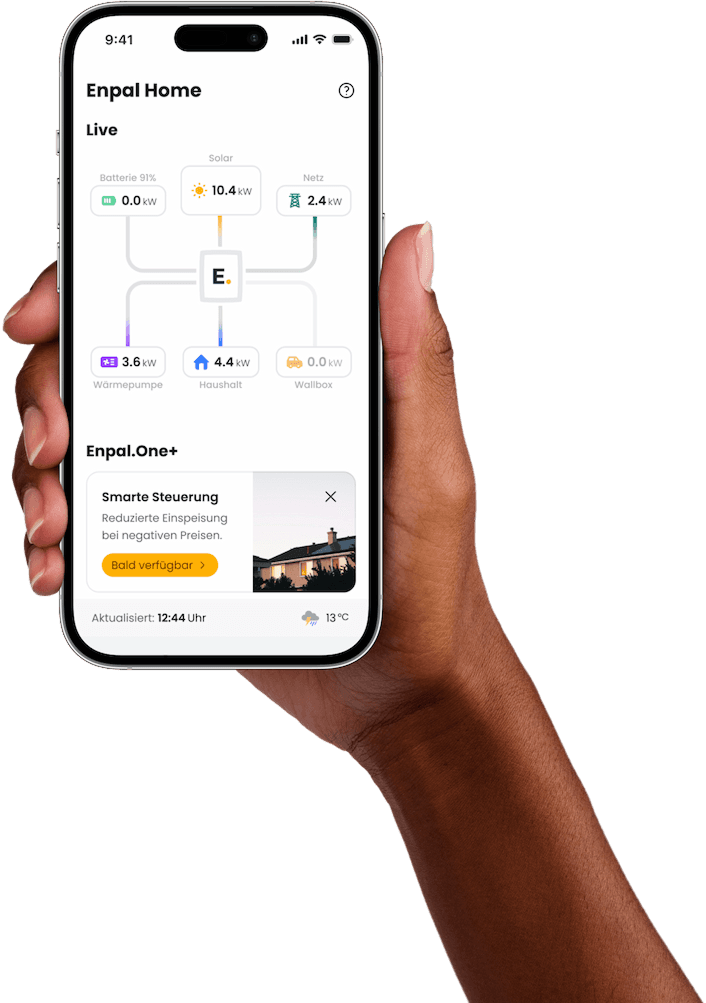
The monitoring app is where Enpal customers live. Our interviews showed usage ranging from several times a week to multiple times a day — people check production, consumption and feed-in almost like a weather app. That habit became both the opportunity and the problem: when Enpal.One+ started actively steering customers' batteries for market trading, the app was exactly where customers noticed their system behaving "wrong." A battery that doesn't charge on a sunny day, or discharges into the grid at night, looks like a malfunction — unless someone explains it's earning you money.
The commercial promise was strong: an energy tariff from 16 ct/kWh (regional average at the time: ~29 ct) plus a Vergütung — a trading compensation of up to €2,000 per year, replacing the old fixed €600 Energiegeld. The design question was harder: how do you make a system that intentionally acts counterintuitive feel like the right decision?
Understanding the customer
Interviews with the first VPP households. In October 2024 we ran qualitative remote interviews with 8 randomly selected customers from the first 200 fully settled VPP test households. The findings set the direction for everything that followed:
Saving money is the main driver — for the solar system and for joining the VPP. Autonomy from the grid is not the real motive; for most people "independence" is just another word for saving money.
The strongest expectation was some form of reimbursement — not a precise amount, but the feeling of having made a smart decision.
"Everything out of one hand" came up in almost every conversation — people don't want to juggle multiple energy players.
The factual understanding of the VPP was fuzzy. Customers wanted a rough mental model, not trading details — but seemingly "illogical" system behavior (battery not charging in sunshine, discharging into the grid) actively damaged trust when left unexplained.
Concept testing the wallet. Testing the Enpal.One+ result screens with customers surfaced more specifics: people know their annual consumption surprisingly well (some track meter readings for 20+ years), but kWh stays an abstract unit — they want euros. Communication was rated as clear "until the intransparent limbo": the months-long wait for full market activation (FMS) with no visible progress. And the consumption cap — the cheap price applies to the first 3,000 kWh — was barely understood: "I read somewhere in the contract that the 17 cents apply to 3,000 kWh. Beyond that, I have no idea what it costs."
The autarky problem. The deepest research question was about one metric. Classic solar apps show "autarky" — how independent you are from the grid. But a VPP intentionally trades with the grid, so on a sunny trading day your "independence" can look terrible while you're earning the most. We ran an in-app survey (694 impressions, 148 responses — 21% response rate) to understand what customers actually mean by autarky:
37% see it as "independence from the power grid," 23% as "maximum use of self-generated solar energy," 22% associate it with cost reduction
After introducing a replacement metric, 31% thought it was "essentially the same" as autarky
72% preferred a percentage of consumption as the unit; 59% preferred the term "grid independence"
The uncomfortable conclusion: customers want an independence metric while participating in a system that inherently contradicts it. Renaming the metric wouldn't fix the misunderstanding — people would map any new term back to autarky anyway. So we kept the familiar concept, avoided prominent re-education, and offered depth on demand: a clear explanation for those who actively look, stating openly that the metric shows what the system does — not financial performance.

What we designed
Onboarding status tracking. A visible journey from signed → energy delivery → FIT → fully market settled. The research showed the waiting phase is where trust dies; a progress state can't shorten the wait, but it replaces silence with a story.
The wallet. The emotional core of Enpal.One+. The Vergütung grows in daily increments with live tracking, and customers can trigger a payout to their bank account from €200 — with automatic payout at year end. Concept tests confirmed the split need: some customers just want the yearly number as proof their calculation works out, others want quick access ("if I need €150 for the weekend"). Daily growth plus flexible payout serves both.
Benefits & savings in euros. An energy tariff page with four numbers: your savings (€), your grid consumption cost (€), your net grid consumption (kWh), and your current price (ct/kWh). Savings were initially benchmarked against the average of the region's 50 cheapest providers; after piloting with the first 200, then 1,000 customers and surveying them, we switched the reference to the local basic supplier — matching how customers actually compare.
Explaining the "illogical." Explainer tiles for battery and grid behavior, a knowledge hub with FAQs, and a short education video triggered at the FMS moment — answering precisely the trust-eroding questions from research: Why does my battery feed into the grid? Why doesn't it charge when the sun shines? Do I pay for the extra grid consumption? Impact is measured as an A/B test: half of new FMS customers see the video, and we compare first NPS entries and support complaints between groups.
Transparency exactly when it matters. The consumption cap only surfaces once a customer has used 80% of it, or a consumption forecast predicts they'll exceed it. Before that, it would be contract noise; after that, it prevents a bad surprise. Once seen, it stays visible.
Outcome
Enpal.One+ became a product customers can see, check and cash out — not a clause in their contract. The wallet turned invisible trading into a visible daily reward, the savings page answers "was this the right decision?" in euros, and VPP customers are surveyed for CSAT every 180 days in-app so the iteration loop never closes.
Reflection
The biggest lesson: in energy products, transparency is not a feature — it's the product. Customers rarely asked for control; they asked for proof, in euros, at the moment doubt appears. And sometimes the right design decision is refusing to be clever — keeping a familiar metric with honest footnotes beat inventing a "more correct" one nobody asked for.